Books
Forgotten (2025)

This profound meditation on memory and what we choose to memorialise, by Raja Shehadeh and Penny Johnson, explores lost connections in a fragmented land. The authors embark on a search for hidden and neglected places in historic Palestine, to ask what has been memorialised, and what lies unseen, abandoned or erased - and why.
What Does Israel Fear from Palestine? (2024)

A searing reflection on Israel’s failure to treat Palestine and Palestinians as equals. While the Berlin Wall crumbled and South Africa abolished apartheid, the Israeli government rejected every opportunity for reconciliation with Palestine. In graceful, devastatingly observed prose, Raja Shehadeh nonetheless offers fresh perspective, suggesting that the two nations can still work together as partners on the road to peace, not genocide.
We Could Have Been Friends, My Father and I (2022)

Finalist for the National Book Award. A moving psychological portrait of the author’s relationship with his father – the lawyer, activist and political detainee Aziz Shehadeh – during the twentieth-century battle for Palestinian human rights. As a young man, Raja fails to recognise his father’s courage. In turn, his father does not appreciate Raja’s efforts in campaigning for Palestinian human rights. When Aziz is murdered in 1985, it changes Raja irrevocably.
Going Home (2019)

Raja Shehadeh reflects on ageing, failure, the occupation and the changing face of Ramallah. Walking along the streets he grew up in, he tells the stories of the people, the relationships, the houses and businesses that are cornerstones of his community. Green spaces have been replaced by tower blocks and concrete lots. The occupation and the settlements have entrenched themselves in every aspect of life. The culture of the city has shifted. This is perhaps Raja Shehadeh's most painfully visceral book.
Where the Line is Drawn (2017)

As a young boy, Raja Shehadeh was entranced by a forbidden Israeli postage stamp in his uncle’s album. He couldn’t have known then what Israel would come to mean to him, or to foresee the occupation of his home in Palestine. Later, he made close friends with several Jewish Israelis, including fellow thinker and searcher Henry. But as life for Palestinians became increasingly unbearable, even the strongest friendships and hopes were put to the test. Raja Shehadeh explores the devastating effect of occupation on even the most intimate aspects of life.
Shifting Sands (2015)

Fifteen writers take a fresh look at the Middle East today, tomorrow and in the past, introduced by Raja Shehadeh and Penny Johnson. Collecting the insights of authors and journalists with deep roots in the region, Shifting Sands examines the catastrophic aftermath of the First World War and the hopes and struggles of uprisings in Egypt, Iran and Syria, questioning the social and political role of writers and artists today. This intelligent, reasoned perspective on life in the Middle East is a breath of fresh air.
Language of War, Language of Peace (2015)

A passionate and elegant reflection on the language of the Middle East conflict, expanded from Raja Shehadeh’s Edward Said Memorial Lectures. The peace process has been ground to a halt by twists of language and linguistic chicanery that have degraded words themselves. No one even knows what the word ‘peace’ might mean now for the Middle East. Another essential book from this master thinker and essayist on the heartbreaking conditions that prevail for ordinary people living along the world’s greatest political fault line.
Seeking Palestine (2013)

How do Palestinians live, imagine and reflect on home and exile? In this volume of new writing edited by Penny Johnson and Raja Shehadeh, fifteen Palestinian writers respond with their reflections, experiences, memories and polemics. Their poignant, intimate and intensely political contributions explore the many individual and collective experiences of seeking Palestine. Contributors include: Lila Abu-Lughod, Susan Abulhawa, Suad Amiry, Rana Barakat, Mourid Barghouti, Beshara Doumani, Sharif S. Elmusa, Rema Hammami, Mischa Hiller, Emily Jacir, Fady Joudah, Jean Said Makdisi, Karma Nabulsi, Raeda Sa’adeh, Adania Shibli.
Occupation Diaries (2012)

Life in Palestine today - what it is really like day to day, drawn from Raja Shehadeh’s intimate daily diaries. It is often the smallest details of daily life that tell us the most. And so it is under occupation in Palestine. What most of us take for granted has to be carefully thought about: When will the post be allowed to get through? Will there be enough water for a bath tonight? How much time should I allow for the journey through the checkpoints to visit my cousin? Raja's sharp eye and compassionate writing shed new light on small questions and the big issues that affect us all.
A Rift in Time (2010)

The poignant and revealing true story of the political struggles of Raja Shehadeh’s remarkable great uncle. Najib was a journalist living in Palestine, then part of the Ottoman Empire. When he voiced his opposition to Ottoman participation in the First World War, a death sentence was put on his head. So he fled, living on the run for nearly three years. The quest for Najib, the details of his life and the route of his great escape consumed Raja. As he traces Najib’s footsteps, he reflects on how Palestine has been transformed, yet still finds it possible to look towards a better future.
PALESTINIAN WALKS (2007)

Winner of the Orwell Prize for Political Writing. When Raja Shehadeh first started hill walking in Palestine, in the late 1970s, he was not aware that he was travelling through a vanishing landscape. This book comprises accounts of six walks in the hills around Ramallah and nearby that span a period of 26 years, each taking place at a different stage of Palestinian contemporary history - the first in empty, pristine hills, the last amongst settlements, revealing the changing political atmosphere as well as the physical transformation of the landscape.
When The Bulbul Stopped Singing (2003)

A diary of life under siege. Battered by repeated suicide bombs, the Israeli army invaded Palestinian territory in 2002 and held many of the principal towns and cities, including Ramallah, under siege. At that time a tank stood at the end of Raja Shehadeh's road; there were Israeli soldiers on the rooftops; his mother was sick, and he couldn't cross town to help her. This is his account of the terror and frustrations, as well as the moments of poignant relief and reflection on the profound crisis gripping Palestinians.
Strangers in the House (2002)

An extraordinary and moving memoir. Raja Shehadeh grew up in Ramallah in the shadow of his father, a leading civil rights lawyer. He vowed not to become involved in politics or law but inevitably did so and became an important activist himself. In 1985 his father was murdered. The Israeli police failed to investigate properly and Shehadeh set about solving the crime that destroyed his family, recounting troubled and complex relationships and his experience of exile, of being a stranger in his own land.
From Occupation to Interim Accords (1997)
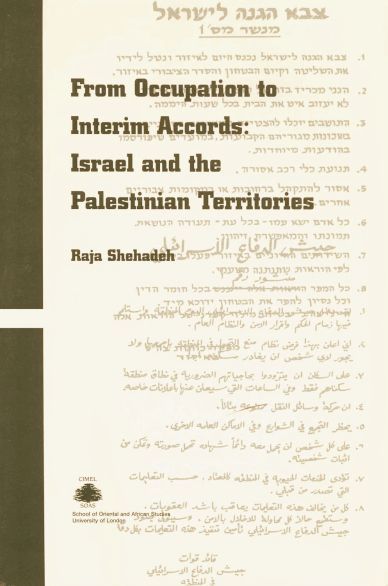
A legal analysis of the lengthy and complicated agreements signed between Israel and the PLO. The legal and administrative developments that took place in the Palestinian areas over the previous twenty years are surveyed and closely analysed. The negotiation process is critically considered and legislation is reviewed. There is an analyses of the legal developments in the areas under the Palestinian Authority which is the first of its kind. The book includes military orders, letters and negotiation documents which have not been previously published.
The Declaration of Principles (1994)
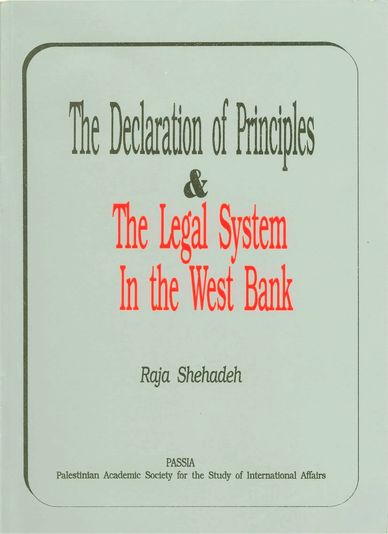
This book-length paper examines the legal system imposed by Israel on the Palestinians of the West Bank, submitted by Raja Shehadeh to the Palestinian Academic Society for the Study of International Affairs (PASSIA), an independent non-profit think tank based in Jerusalem, as part of their Programme for Democracy 1993-94. The work analyses the Oslo Declaration of Principles and its impacts on the legal framework, legislation, and the judicial system in the West Bank, discussing the changing dynamics between lawyers, judges and professional associations during the peace process era.
The Sealed Room (1992)
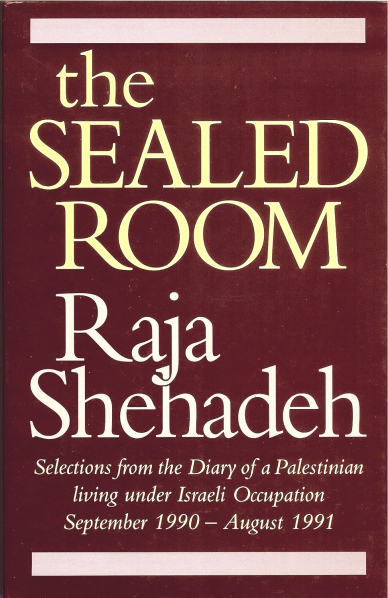
Raja Shehadeh’s diary of the tense months in 1990-91 when the first Gulf War overshadowed the first Intifada. The al-Aqsa massacre and its aftermath inflame tensions between Palestinians and Israelis. The Israeli government’s manipulation of its own population becomes clear. At the same time, the Israeli army exploits the crisis to wage its own fierce campaign against the Intifada. Ever more oppressive security regualations are imposed that outlast the war.
Occupier’s Law (1985)
Occupier’s Law (1985)
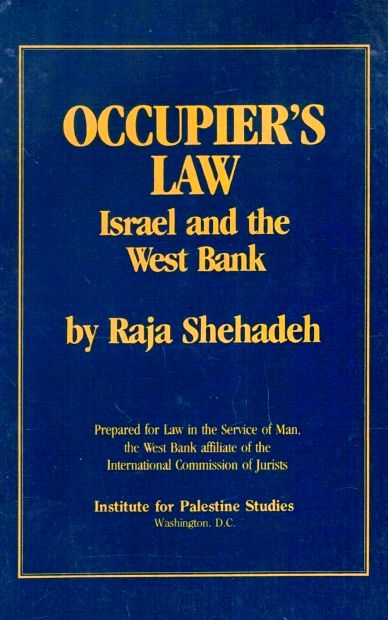
A seminal study in which Raja Shehadeh argues that the policy which Israel has been pursuing in the West Bank since 1967 is intended to drive out the Palestinians, to take over their land and eventually to annex the occupied territories. The study describes the various methods of confiscation of land and building of settlements, as well as legislative, judicial and military measures adopted by Israel.
The Third Way (1982)
Occupier’s Law (1985)
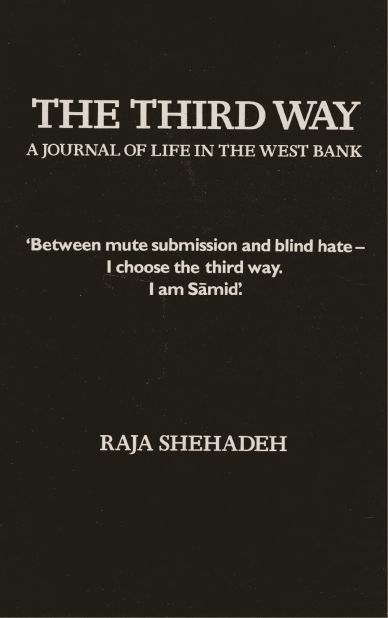
Vignettes of Palestinian life presented by Raja Shehadeh as a young man in Ramallah - deeply personal and profoundly insightful. As he writes: ‘My problem with the newspapers is that I can’t settle on the right time to read them. In the morning they darken the day, at noon they kill my appetite, after lunch they make me sick, and in the evening they set the pattern of my nightmares.’ Published in the US as ‘Samed: Journal of a West Bank Palestinian’.
The West Bank and the Rule of Law (1980)
The West Bank and the Rule of Law (1980)
The West Bank and the Rule of Law (1980)
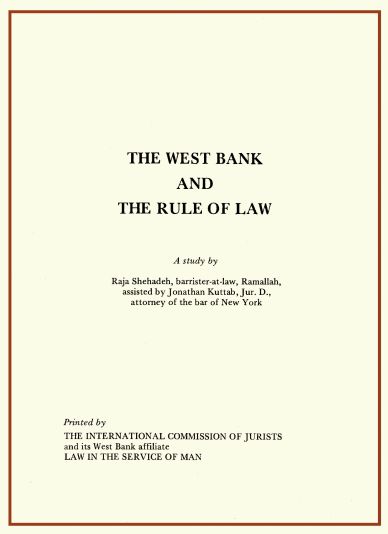
This Al-Haq report by Raja Shehadeh and Jonathan Kuttab is an analysis of the legal situation in the Israeli-occupied West Bank. It includes detailed studies of the legislation and administration of land rights, water rights, trading and commerce, town planning, trade unions, education, literature and information. The report establishes that Israel has altered the existing laws and administration in such a way as to make the economy of the West Bank subordinate to the interests of Israel, and to facilitate the encroachment on the territory of Jewish settlements, which are universally condemned as a violation of international law.